Infomaniak launches new S3-compatible object storage in its sovereign Public Cloud
Published on November 6, 2026 by Team Infomaniak
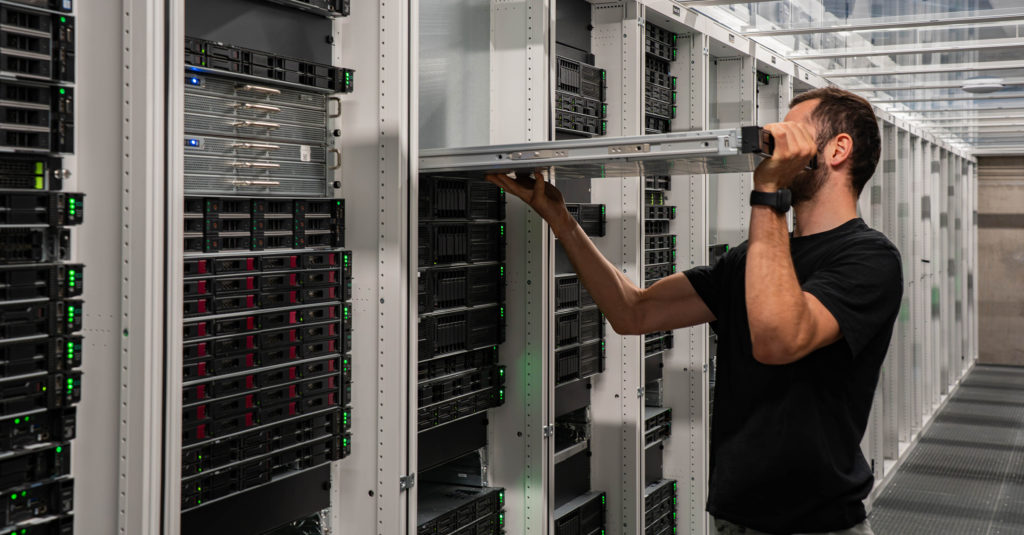
Infomaniak’s Public Cloud now includes a new object storage service with native S3 compatibility. It lets businesses, developers and DevOps teams store their media, application files, logs, AI data, archives or backups. Infomaniak hosts this data in its own data centres in Switzerland, under Swiss law, and can replicate it to a second data centre at the flick of a switch. The data is encrypted, spread across several availability zones and can be locked against any change or deletion for a period of your choice.
A new service alongside the existing one
Our Public Cloud already offered object storage based on OpenStack Swift, with basic S3 compatibility. That service remains available. If you use it, you don’t need to change anything. Your containers, credentials and applications keep working as before.
The new service is built on Ceph and speaks S3 natively. It gives you five new capabilities:
- Automatically replicate your data to a second region, hosted in another data centre in Switzerland.
- Lock your files against any change or deletion with Object Lock, for as long as you choose.
- Keep previous versions of your files and roll back when you need to.
- Encrypt your data with your own keys.
- Use your existing S3 tools without any adjustments.
This is the service we recommend for your new projects.
To move to the new service, just create new credentials and new buckets, then copy your data across. With rclone, it only takes one command.
rclone copy old:my-container new:my-bucket --progressIn this command, old and new are the two remotes you have set up in rclone. It copies every file and leaves the original container untouched. You can then test your applications on the new service before switching over, and delete the old containers afterwards. The documentation compares the two services and walks you through each step.
Storage built for large volumes of files
Object storage keeps your files in spaces called buckets. Each file is accessible through the S3 API, from your scripts, applications or backup software. This type of storage suits large, fast-growing volumes, for example:
- Images, videos and podcasts for your websites and applications, which you can serve through a CDN.
- Datasets, checkpoints and results from your AI projects.
- Your application files, such as documents uploaded by your users.
- Backups and archives of your servers and databases, with tailored retention rules.
Keep your data safe from ransomware
In an attack, ransomware often goes after backups first. Attackers steal credentials, erase or encrypt the copies, then move on to production data. The business is left with nothing to restore from and faces a ransom demand.
The new object storage lets you build a multi-layered defence. These protections work together, so a single stolen login is not enough to wipe everything.
- With Object Lock, you can lock your files for as long as you choose. During that period, no one can change or delete them, not even with a compromised administrator account.
- Versioning keeps previous versions of every file. You can roll back to an older version without overwriting the current one. You also decide how many versions to keep and for how long.
- Replication copies your data to another of our data centres in Switzerland. This copy also mirrors deletions. Combine it with versioning or Object Lock so that a deletion doesn’t carry over.
- Encryption protects your data at rest and in transit. You can also use your own encryption keys (SSE-C). The key is sent with each request and the service does not store it.
These features fit into the 3-2-1 backup rule. It recommends keeping three copies of your data, on two different types of media, with one stored off-site. The new object storage can serve as that off-site copy, locked and replicated in Switzerland, in a fully sovereign cloud. For turnkey backups of your computers, NAS devices or servers, Swiss Backup remains our dedicated solution.
Your data stays available, even during an incident
Your data is spread across several availability zones. If one of them is hit by an incident, the others take over.
The service is covered by an availability commitment (SLA), which is strengthened when replication is enabled.
Your S3 tools work as they are
The new service uses the S3 protocol. To connect your scripts and applications, all you need to change is the endpoint address and your credentials.
It works with the AWS CLI, s3cmd and rclone command-line tools, with SDKs such as boto3, with Terraform and Ansible, and with your GitLab, GitHub Actions or Jenkins pipelines.
If you prefer a graphical interface, a built-in web explorer lets you manage your buckets, access rights and files from your browser. You can make a file or folder public, or share a file for a limited time using a presigned URL.
The same standard lets you move your data from another S3-compatible provider without rewriting your applications, and move it out again just as easily.
Pay only for what you use
The service is billed on a pay-as-you-go basis, with no commitment. You pay for the space you actually use, without reserving capacity in advance. There is no charge for requests, however many reads or writes you make. Up-to-date pricing and a calculator are available on the Public Cloud pricing page.
Another building block in your Public Cloud
Object storage joins the other building blocks of our Public Cloud (IaaS). The Public Cloud already includes virtual machines and their disks, private networks, load balancers and public IP addresses protected against DDoS attacks. It also offers managed DNS, managed Kubernetes and managed databases. For AI, you can rent GPU instances on a pay-as-you-go basis, and AI Services gives you access to open-source models that we host in Switzerland, through an OpenAI-compatible API.
Ceph is an open-source storage technology that we already run at scale, including for SwissTransfer. Our Public Cloud is built on OpenStack, which we have used since 2012 and which our teams contribute to directly.
Sovereign and responsible
This object storage is part of our sovereign cloud. Your data stays in Switzerland and is governed by Swiss law, with no intermediary subject to extraterritorial legislation. The service is run by our teams based in Switzerland and meets the requirements of the GDPR and the Swiss Data Protection Act.
Our data centres run on certified local renewable electricity and are cooled without conventional air conditioning. A significant share of this electricity is recovered as heat and fed into the district heating network. These choices are part of our environmental commitments.
We are certified to ISO 27001 for information security, ISO 9001 for quality, and ISO 14001 and ISO 50001 for our environmental and energy management. Our Trust Center sets out our security measures and compliance documents, including the data processing agreement (DPA) provided for under the GDPR.
Get started in minutes
- Create your Public Cloud in the Infomaniak console.
- Generate an access key and a secret key for the new object storage.
- Set up your usual tool with the endpoint given in the documentation, then test the connection.
Find out more


No comments
No comments yet.