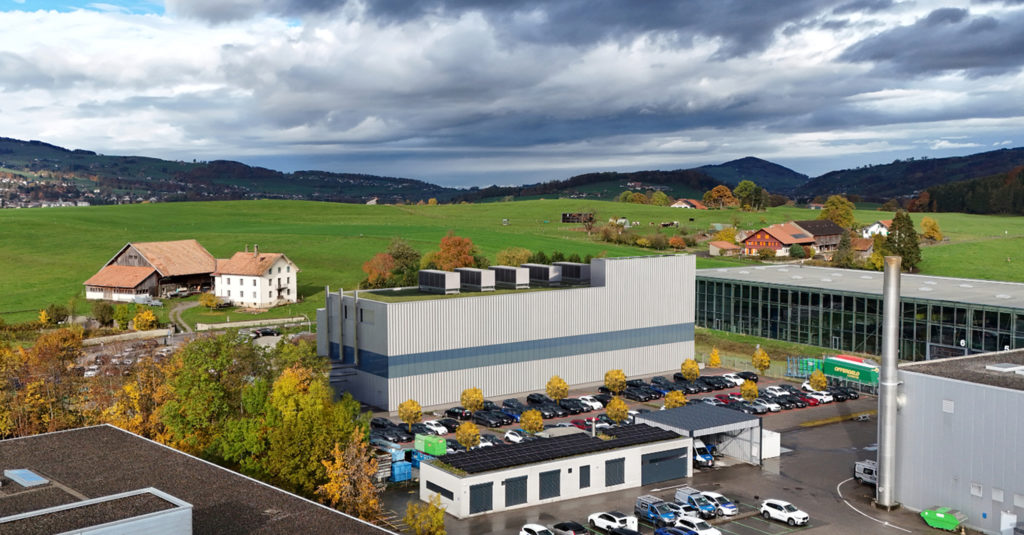
Infomaniak is preparing a new data centre in Bulle, for your data and for AI
Published on November 13, 2026 by Team Infomaniak
With Gruyère Energie, Infomaniak plans to build a new data centre in Bulle, in the canton of Fribourg. The planning application has been on public display since 13 November 2026. The data centre is to offer twice the capacity of our D4 data centre in Geneva, to support the growth of our cloud and AI services. It is designed so that all the heat from its servers is put to use in Gruyère Energie’s district heating network, with no water drawn for cooling. Commissioning is planned for 2028, subject to the necessary permits.
Why a new data centre
When you save a file to kDrive, back up your computers with Swiss Backup or ask our sovereign AI assistant Euria a question, a server is at work in one of our data centres in Switzerland. By using our services, you help build sovereign, independent technology that protects privacy, supports the local economy and keeps its environmental footprint to a minimum. More and more of you are making this choice. Thank you.
The Bulle data centre is intended to help us meet this demand. Its planned IT capacity is 2.5 megawatts, twice that of D4. It remains a human-scale data centre. The building will have a footprint of around 1,200 m², barely a quarter of a standard football pitch.
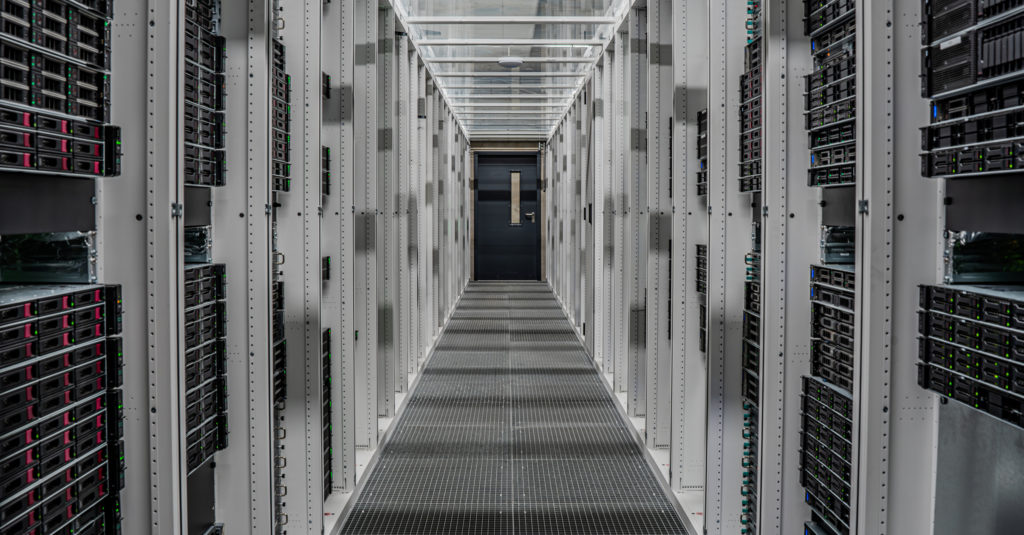
It is to house two types of server:
- Storage servers, which hold data such as your emails, websites, kDrive files and Swiss Backup backups.
- Compute and AI servers, which run applications and AI models, such as our Euria assistant, our AI services for developers and the on-demand GPU instances in our Public Cloud.
A server turns almost every watt of electricity it consumes into heat. At Infomaniak, we want to give that heat a second life. Our fourth-generation data centre, D4, inaugurated in Geneva in January 2025, is designed to feed all of it into the district heating network, all the time. In Bulle, we want to go further with the compute and AI servers, the ones that run hottest.
Why Bulle
As with D4, we wanted a site where all the heat from our servers could be put to use, in summer as well as in winter. The district heating network run by Gruyère Energie, which is supplied by more than 95% renewable energy, meets this requirement. It is already in operation and runs right next to the plot, which keeps the connection work to a minimum.
The site also meets the requirements we set for all our data centres:
- a power supply from several sources
- redundant, independent fibre-optic connectivity
- an existing business zone
- land outside areas of geological risk
Finally, Gruyère Energie shares our wish to bring digital and energy networks closer together, to create more value locally.
How the heat from the servers will be recovered
Under the planned technical concept, the data centre will combine two cooling methods, each suited to one type of server.
Storage servers will be air-cooled
This cooling follows the same principle as in our D4 data centre in Geneva. Air flows through the servers, warms up as it passes over the IT components, then is directed to a heat recovery system. A heat exchanger then transfers the heat from the air to a closed water circuit.
This heat is then taken up by Gruyère Energie’s heat pumps, which raise its temperature to match the needs of the Bulle district heating network. The water in the circuit leaves the heat pumps cold. It returns to the heat exchanger, where it cools the air in turn. The cooled air flows back to the servers, and the cycle starts again.
Compute and AI servers will be liquid-cooled
These servers use more electricity and therefore give off more heat. A liquid will circulate in a closed loop, in direct contact with the chips, where the heat is produced. It captures and carries heat more efficiently than air. This direct liquid cooling brings a twofold benefit:
- An IT benefit: it removes high thermal loads, in line with the needs of next-generation servers.
- An energy benefit: it recovers heat at a higher temperature, which improves the conditions for putting it to use in the district heating network. This can improve the efficiency of the heat pumps and reduce the electricity needed to make use of this heat.
In both configurations, the recovered heat is intended to be put to full use by the heat pumps, then delivered to the Bulle district heating network. This approach turns heat usually regarded as waste into a useful energy resource for the region, in summer and winter alike.
Gruyère Energie’s heat pumps then take over
They work like a refrigerator. They draw the heat out of the water returning from the servers, and this cooled water flows back to the servers. But where a refrigerator releases its heat into the kitchen, they bring it up to the temperature of the district heating network. Cooling the servers and producing heat for the network thus become two functions of one and the same system, with no air conditioning.
At full load and under normal operation, the servers’ 2.5 MW of electricity is thus expected to provide around 2.5 MW of heat continuously, at a constant temperature. According to Gruyère Energie’s estimates, each year the site is expected to:
- supply around 28 GWh of heat to the network, after the heat pumps
- avoid around 2.8 million litres of heating oil, whose combustion would have emitted up to 7,500 tonnes of CO₂
“In Bulle, the goal is for all the electricity consumed by our servers to end up as useful heat in Gruyère Energie’s network. That is what every data center built today should do: recover its heat, not withdraw water needed for other uses, and be transparent about the resources it consumes,” explains Julien Bonnat, Head of Data Center at Infomaniak.
Water, land and noise
Cooling will not draw any water
In Bulle, water will circulate in closed loops inside the building. Once these loops have been filled, cooling will no longer consume any water.
The building is to stand on previously developed land
The project does not use any farmland or affect any natural areas. No trees will need to be felled, and the roof is to be partly green, with rainwater retention.
The facilities are designed to comply with noise standards
The site is located in an industrial zone. Neighbours’ comfort is taken into account right from the design stage. A firm of acoustic engineers is studying each outdoor installation, one by one. Depending on the case, it specifies acoustic screening or low-noise equipment, in order to comply with the Swiss Noise Abatement Ordinance.
Another step towards reducing our footprint
Each generation of our data centres goes further than the last. Before 2013, the first two generations, already powered exclusively by renewable electricity, taught us to do without air conditioning. We have decommissioned them, as their footprint no longer met our standards.
The third generation eliminated air conditioning altogether. More than 90% of its electricity goes to the servers, which means a PUE below 1.1. This energy efficiency has earned us several awards, including the Cantonal Sustainable Development Prize in Geneva.
The fourth received the Green Business Award 2026. It is designed to recover 100% of its heat, still without air conditioning. The fifth, in Bulle, is intended to go even further, with liquid cooling that makes this heat recovery more efficient.
“What sets the project apart is its hybrid cooling. Both methods share the same goal of recovering all the heat produced. And as AI processors become more powerful every year, this choice prepares us for tomorrow’s equipment,” explains Nicolas Verney, Data Center Project Manager at Infomaniak.
In this video (in French), our teams explain how they design and operate our data centres.
Your data stays in Switzerland
As in our other data centres, we will host the data in Bulle ourselves, in our own infrastructure in Switzerland. It will be governed by Swiss law, with no intermediary subject to extraterritorial legislation. This is one of the principles of our sovereign cloud.
Our certifications page sets out the international standards we comply with, and our Trust Center details our security measures and compliance documents.
What happens next?
The planning application has been on public display since 13 November 2026. If the permits are granted, construction is envisaged to start in the first half of 2027, with commissioning planned for 2028.
Find out more


No comments
No comments yet.