The environmental footprint of building Infomaniak’s D4 data centre
Published on April 15, 2026 by Team Infomaniak
In 2024, Infomaniak’s greenhouse gas emissions fell significantly. This drop is partly due to the completion of our new D4 data centre. Its construction accounts for 1,961.9 tonnes of CO₂e, recorded in the 2023 report. To help understand the scope of this impact, we are sharing a detailed analysis of the D4 construction phase, covering everything from materials used to technical installations.
View the environmental report for the construction of the D4 data center
How D4’s construction is reflected in our GHG report
The construction of the D4 data centre accounts for 1,961.9 tonnes of CO₂e in our greenhouse gas emissions report. These emissions relate to the construction phase carried out in 2023. As building infrastructure is part of running our cloud, these emissions are included in our climate report.
To ensure a consistent view of emissions over time, this impact was retrospectively assigned to the 2023 reporting year. 2024 therefore represents D4’s first full year of normal operations.
The reduction seen between these two years is largely the result of moving from a year that included infrastructure construction to one that reflects normal ongoing operations.
What the construction report measures
The report focuses exclusively on the “Construction” scope of D4. It analyses the environmental impact of materials, the manufacture of technical equipment, the construction work itself, and end-of-life disposal. This covers the footprint of the building and its technical installations: the structure, electrical systems, thermal systems, and all fixed components required for the infrastructure to operate.
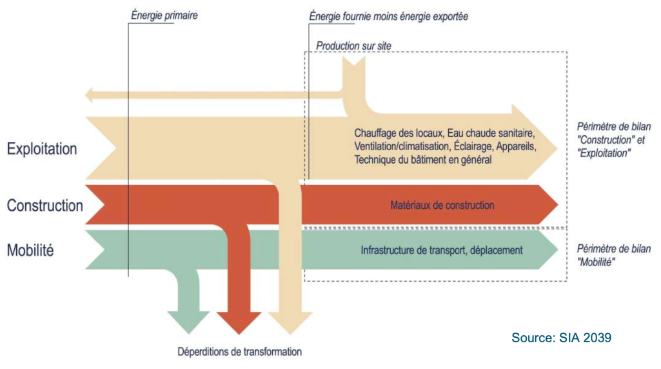
IT hardware is not included in this scope, as servers are deployed gradually in line with demand, and their impact is already accounted for annually in our GHG reports. This distinction between the shell (the building) and the contents (the servers) avoids double-counting and provides an accurate picture of the construction impact itself.
The main source of emissions in the D4 data centre construction
Carbon footprints of buildings are often associated with concrete. In the case of D4, the underground structure (foundations, raft slabs* and load-bearing walls) accounts for 23.4% of the total construction carbon footprint. Adding interior and exterior construction elements, which account for 18.7%, gives a combined total of 42.1%. Concrete is therefore the second largest source of emissions.
*A raft slab is a shallow reinforced concrete foundation in the form of a continuous slab covering the entire footprint of the building.
The data centre’s technical equipment (electrical installations, transformers, ventilation and cooling systems) is the largest source of emissions in D4’s construction, accounting for 57.3% of total emissions — 44.1% from electrical installations alone, followed by heating and ventilation systems.
The majority of emissions stem from the manufacture of materials. In total, 90.5% of the carbon footprint occurs upstream, during the production of construction materials and technical equipment. D4’s construction required, for example, 16.2 tonnes of copper for cabling, around 14.4 tonnes of aluminium, more than 16 tonnes of structural steel, and 3,226 tonnes of concrete for underground walls, the raft slab, and floor-bearing structures.
Measuring environmental impact goes beyond CO₂
Beyond CO₂ emissions, a second indicator helps complete the picture: embodied energy. This refers to the total non-renewable energy (oil, natural gas, coal, etc.) required to extract, process, and transport materials before they reach the construction site.
For D4, this energy covers:
- the manufacture of cement and steel used in the structure
- the production of cables, transformers, and electrical equipment
- the machining of ventilation and cooling systems
- the transport of these components to the construction site
- the disposal of materials at the end of the data centre’s life.
In total, this amounts to 7,376 MWh.
In addition to CO₂ emissions and embodied energy, the report uses the UBP (Umweltbelastungspunkte / Environmental Impact Points), an indicator used in lifecycle assessments in Switzerland to aggregate various construction-related impacts into a single unit. It takes into account:
- air pollution from industrial activities related to the building’s construction
- consumption of natural resources (metals, raw materials)
- substances that disrupt aquatic ecosystems (eutrophication)
- certain forms of toxicity affecting natural environments
For D4’s construction, the combined total of these effects amounts to 4,188 million UBP.
D4 is designed to last at least 60 years
The D4 data centre is designed to operate for at least 60 years (expected lifespan). The carbon footprint of its construction is calculated over this period and must therefore be viewed in a long-term perspective. Should D4 cease to be used before reaching 60 years of operation, the site could easily be repurposed, particularly since the building has no visual impact on the surrounding landscape, being built underground.
The construction report (lifecycle analysis) also factors in the future replacement of certain technical components. Including these renewals, D4’s total footprint over its entire lifespan reaches 5,566 tonnes of CO₂e.
Heat generated by D4’s servers is recovered and fed into the district heating network. This recovery is not part of the construction footprint, as it falls within the operational phase. Ultimately, D4 will contribute to heating up to 6,000 homes.
A new milestone in Infomaniak’s environmental approach
This report marks a milestone in Infomaniak’s environmental approach. For the first time, it allows us to incorporate into our greenhouse gas (GHG) emissions report the physical impact of the building and its constituent materials, in accordance with applicable calculation standards (Building Construction Cost Code eCCC-Bât:2020 Construction Domain, in line with SIA technical guidelines 2032:2020 and 2040:2017).
This analysis makes visible a part of the digital footprint that is often absent from climate reports: the construction of the infrastructure itself.
It also lays the groundwork for an approach we will now apply to all future infrastructure projects, measuring their impact from the construction phase onwards.




No comments
No comments yet.